
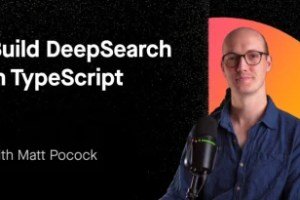
Matt Pocock (AIhero) – Build DeepSearch in TypeScript: A Complete Guide to Next-Level Search Functionality
Introduction
In the world of modern development, Matt Pocock (AIhero) – Build DeepSearch in TypeScript has emerged as a game-changing framework for building intelligent, scalable, and high-performance search systems. As applications become more data-driven, the demand for efficient search capabilities that go beyond simple keyword matching has exploded. That’s where DeepSearch comes in — a cutting-edge concept developed by Matt Pocock, a leading TypeScript educator and creator known for his deep insights into AI-assisted software engineering.
This guide explores the fundamentals of DeepSearch, the power of TypeScript in AI-driven search applications, and how Matt Pocock’s (AIhero) approach is transforming how developers build, optimize, and scale intelligent search systems for real-world applications.
1. Who Is Matt Pocock (AIhero)?
Before diving into the technical core of DeepSearch, it’s essential to understand the mind behind it. Matt Pocock, known in the dev community as AIhero, is a TypeScript thought leader, educator, and software innovator who has trained thousands of developers to write cleaner, safer, and more scalable code. His work combines the precision of TypeScript with the creativity of artificial intelligence to simplify complex systems.
The AIhero brand represents the new era of programming where AI helps accelerate development, enhance code intelligence, and automate repetitive tasks. With Build DeepSearch in TypeScript, Matt Pocock introduces a refined blueprint for constructing advanced search engines that can understand data contextually, semantically, and deeply — just like a human.
2. What Is DeepSearch in TypeScript?
DeepSearch is more than a simple search function — it’s a semantic search architecture that combines the structure of TypeScript with AI-assisted logic. It’s designed to retrieve not just matching keywords but relevant meaning from large and complex datasets. Think of it as building Google-like intelligence into your own app.
While traditional search algorithms rely on direct keyword matching or string comparisons, DeepSearch focuses on contextual matching, entity understanding, and relevance scoring. By leveraging TypeScript’s type safety and AI-driven models, it becomes easier to build scalable search engines that can adapt to evolving data structures.
Key Features of DeepSearch:
-
Context-aware querying
-
Type-safe search logic
-
AI-assisted indexing
-
Predictive relevance scoring
-
Extensible architecture for any dataset
In essence, Matt Pocock (AIhero) – Build DeepSearch in TypeScript enables developers to bridge the gap between structured data and intelligent query interpretation.
3. Why TypeScript Is the Perfect Fit for DeepSearch
TypeScript is the backbone of DeepSearch’s reliability and scalability. Its static typing system helps developers prevent runtime errors while maintaining flexibility through interfaces and generics. For complex search logic, this combination is invaluable.
Benefits of Using TypeScript for DeepSearch:
-
Type Safety: Reduces bugs when handling dynamic data structures.
-
Predictive Autocompletion: Makes query building intuitive and error-free.
-
Scalability: Enables developers to handle millions of records without performance drops.
-
Seamless Integration: Works with AI APIs, vector databases, and machine learning models.
-
Better Collaboration: Clear type definitions improve teamwork in large projects.
By embedding TypeScript at the foundation, DeepSearch ensures performance stability while integrating advanced AI components.
4. The AIhero Framework: Combining AI and TypeScript
The brilliance of Matt Pocock (AIhero) – Build DeepSearch in TypeScript lies in how it merges artificial intelligence with static typing. The AIhero framework leverages natural language processing (NLP) and vector search techniques to understand search intent — not just syntax.
Through the integration of models like OpenAI embeddings or local transformer models, DeepSearch can interpret user queries semantically. For instance, searching for “affordable laptops” will also retrieve results for “budget notebooks” because DeepSearch understands their relationship in meaning.
Core AIhero Components:
-
AI-powered Indexing: Embeds data into semantic vector space for fast retrieval.
-
Deep Context Matching: Uses embeddings to score result relevance.
-
Adaptive Learning: Improves over time with user feedback.
-
Type-Aware Parsing: Ensures search results conform to expected data types.
This combination of AI precision and TypeScript structure is what makes the DeepSearch model so powerful and adaptable.
5. Building DeepSearch in TypeScript: Step-by-Step Overview
While Matt Pocock’s (AIhero) course and framework go in-depth, let’s break down the general approach to constructing a DeepSearch system using TypeScript principles.
Step 1: Define the Data Model
Use TypeScript interfaces or types to structure your data.
Step 2: Create a Search Index
Transform raw data into an embeddings-based index. Each record is converted into a vector representation through an AI model such as OpenAI’s text embeddings.
Step 3: Implement the Search Algorithm
Use cosine similarity or Euclidean distance to measure how close a query vector is to your indexed data vectors.
Step 4: Rank Results
Integrate a scoring function that prioritizes relevance based on query intent, data type, and confidence level.
Step 5: Optimize and Scale
Add caching, pagination, and asynchronous data retrieval for large datasets.
This structure allows developers to build flexible search systems that grow and adapt alongside their applications.
6. Use Cases of DeepSearch
Matt Pocock (AIhero) – Build DeepSearch in TypeScript is applicable across industries and use cases where precision and context matter.
Practical Applications:
-
E-commerce: Semantic product search for personalized shopping experiences.
-
Knowledge Management: Advanced document retrieval in enterprise systems.
-
Customer Support: AI-driven FAQs that understand intent.
-
Healthcare: Contextual medical data retrieval and diagnostics.
-
Software Tools: Code search engines for developer platforms.
Each implementation benefits from TypeScript’s type accuracy and AIhero’s adaptive intelligence — ensuring faster and more meaningful search results.
7. Why Developers Love Matt Pocock’s DeepSearch Framework
Developers praise Matt Pocock (AIhero) – Build DeepSearch in TypeScript for combining clarity, education, and innovation. His framework makes complex AI principles accessible while maintaining professional-grade coding standards.
Top Developer Advantages:
-
Open-source friendly and modular architecture
-
Beginner-friendly documentation
-
AI-ready integration for real-world projects
-
Type-safe utilities for better debugging
-
Future-proof scalability with minimal overhead
By blending AI education with hands-on code experience, Matt Pocock empowers developers to think creatively and technically at once.
8. Performance and Optimization Techniques
For DeepSearch systems to perform at scale, optimization is crucial. Matt Pocock’s teachings emphasize efficiency through TypeScript design patterns and AI-based indexing techniques.
Optimization Strategies:
-
Use vector databases like Pinecone or Weaviate for large-scale embeddings.
-
Implement parallel processing for faster query resolution.
-
Leverage memoization to cache recurring queries.
-
Utilize TypeScript decorators for modular logic injection.
-
Apply AI-based ranking functions to refine user experience dynamically.
These methods make DeepSearch not just powerful but also enterprise-ready.
9. The Future of DeepSearch and TypeScript in AI
The evolution of DeepSearch reflects a broader shift toward intelligent, context-aware search systems. With TypeScript’s growing dominance and AI’s continuous advancement, the synergy between typed programming and neural networks will define the next generation of software development.
As more developers adopt AI-powered frameworks, Matt Pocock (AIhero) continues to lead the conversation on AI-assisted coding, semantic indexing, and intelligent automation. His commitment to blending education, open-source contributions, and scalable architecture sets the stage for a future where TypeScript is the language of intelligent systems.
10. Conclusion
Matt Pocock (AIhero) – Build DeepSearch in TypeScript isn’t just a project — it’s a movement toward smarter, cleaner, and more capable software engineering. By combining TypeScript’s strong foundations with AI-driven intelligence, Matt Pocock has created a system that allows developers to build search engines that think, learn, and evolve.
In a world where data is growing exponentially, the ability to search deeply and meaningfully is invaluable. DeepSearch represents the future — a bridge between human context and machine precision.
If you’re serious about creating next-level applications, learning from Matt Pocock’s AIhero methodology will transform how you approach development, architecture, and problem-solving forever.




Reviews
There are no reviews yet.